
Size guide: the importance of measuring | ||
Choosing the right size is essential for comfort, range of motion, and the aesthetics of the leotard. A well-fitted leotard guarantees the best performance.
The fabric: stretchabilityIt is important to remember that the fabric of a leotard (often lycra, spandex, or a similar blend) is inherently very stretchy. It is designed to be worn close to the body, offering a "second skin" feel
How to take accurate measurements?To determine your size accurately, you need to take four main measurements. Use a soft tape measure and make sure the person being measured stands straight, without tensing their body. Do not add any allowance to your measurements. 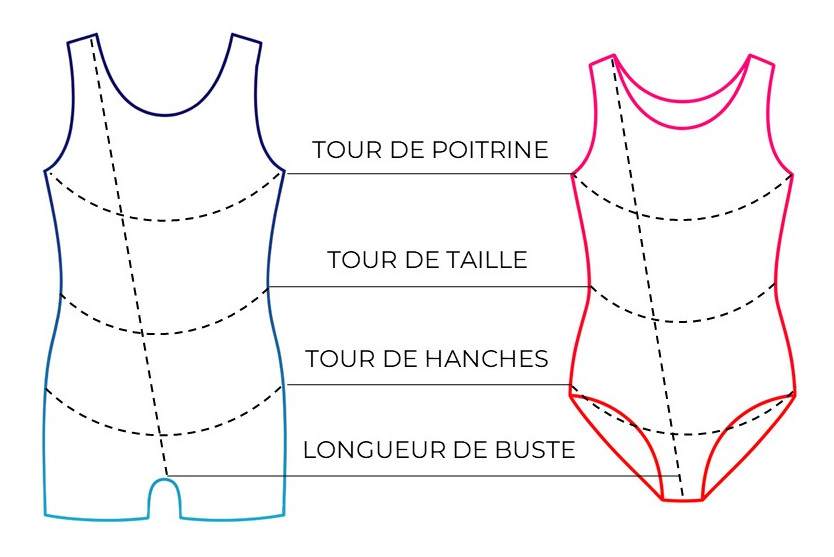 Bust circumference Wrap the tape measure around the fullest part of the chest. The tape should be horizontal and just tight enough not to slip.
Waist circumference Measure the narrowest part of the waist, usually just above the navel. Do not suck in your stomach; breathe normally.
Hip circumference Measure around the widest part of the hips and buttocks.
Torso length This measurement determines the length of the leotard. It ensures that the leotard is neither too short (cutting into the crotch) nor too long (bunching up). Place the tape measure over the shoulder. If the person is wearing a top with a shoulder seam, use it as a starting point. Then let the tape run down the body to the bottom of the crotch.
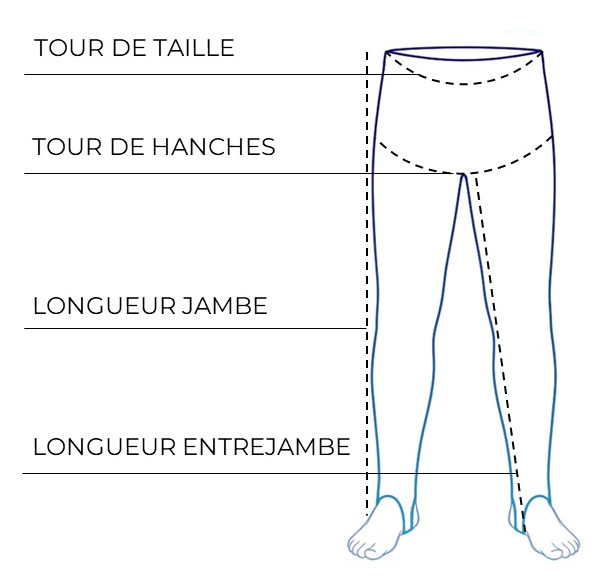 Leg length Place the start of the tape measure on the side of the hip (at the hip bone) and go straight down to the floor. Stand up straight while measuring.
Inseam length Measure from the top of the crotch down the inside of the leg to the floor.
Comparison with Dressing D dataOnce you have your four precise measurements, without adding centimeters, compare them to the information provided for each model. Fit tip: Dressing D measurements are taken flat. If the measurements you took of yourself (your child, your gymnast...) are slightly larger than the model's (up to 5 cm), the leotard will adapt perfectly thanks to the elasticity of the fabric. Conversely, it is not recommended to choose a leotard for which your measurements are smaller, as the support would not be optimal for practice. Pay attention to specific materials: each model is unique. If the fabric used has lower-than-normal elasticity, this will always be mentioned in the "Information" section of the product sheet. We invite you to read this section carefully before making your choice. Priority: in case of doubt or if your measurements correspond to two different sizes, always prioritize the size over the torso length because length is the key to a proper leotard fit. |